Product Case
Analysing Service Design problems from user needs and business goals
Service research and redesign of a mobile app based on problems identified in the user journey.
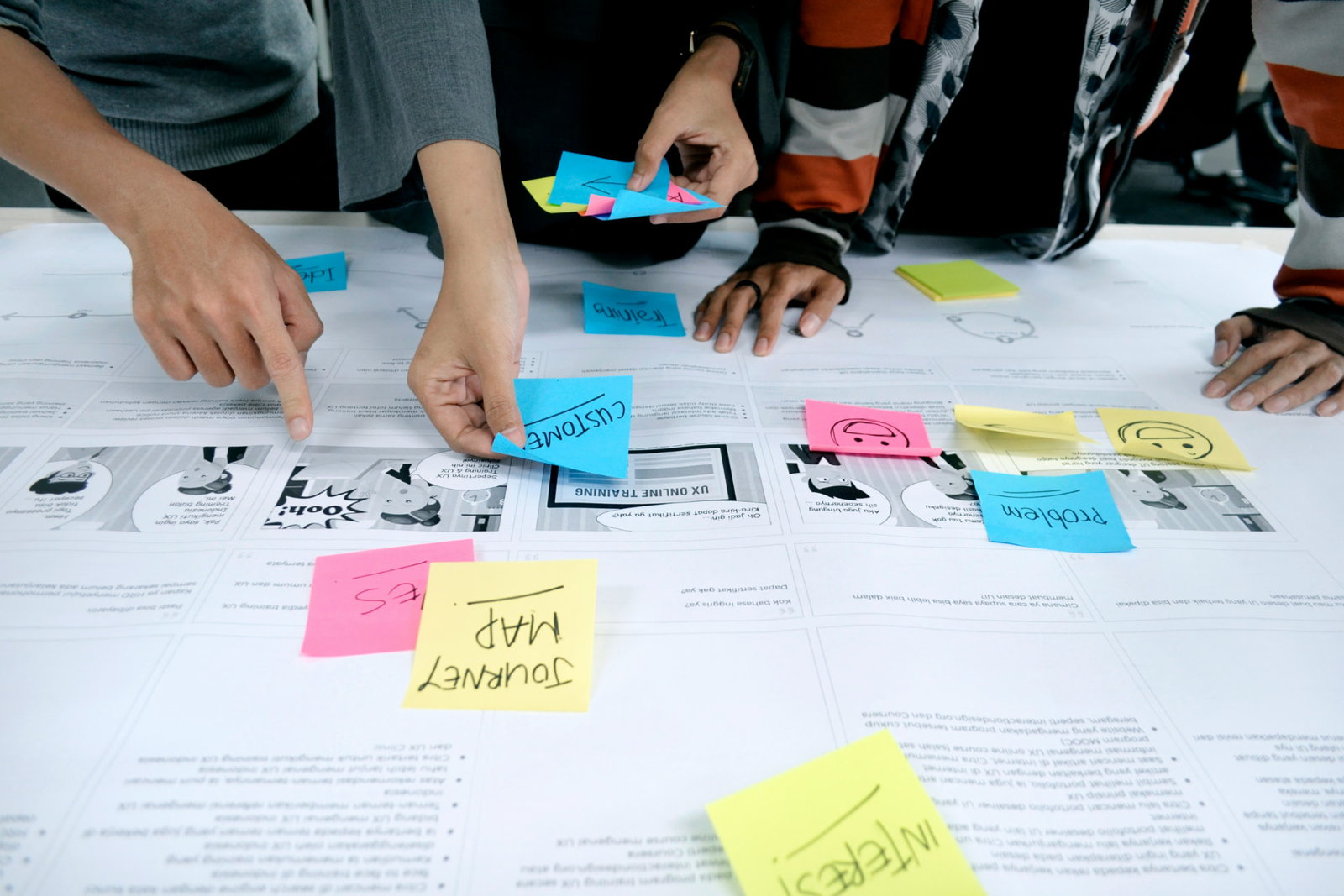
Reference image — real project materials cannot be disclosed due to confidentiality.
Initial insight
This app has very few active users.
Context
The client came to us because the app had few active users and wanted to understand how to improve the experience and increase engagement.
Instead of assuming the problem was in the interface, we decided to investigate the service as a whole. We needed to understand how the app fit into users' journeys and whether usability was really the main barrier.
The challenge, therefore, stopped being just redesigning an interface and became understanding why the app was not being used.
Approach
We started with qualitative research to understand the service from the perspective of those who used it. I conducted shadowing, observing users in real situations, contextual interviews, and in-person user interviews.
We also talked to professionals from the different internal areas involved in the service, seeking to understand how the teams related and what problems happened behind the scenes of the experience.
To complement the qualitative data, we ran a quantitative survey, promoted on the client's social media, with questions about the company, the service, and the app.
Finally, I conducted a heuristic analysis of the journey inside the app, seeking to identify friction points and usability issues.
The combination of these approaches allowed us to cross-reference the perspectives of users, internal teams, and the product itself before making design decisions.
Research insight
Research showed that the problem was bigger than the interface: the app did not solve a relevant problem for users within the service.
The initial brief
We need to increase app usage.
What research revealed
The problem was not just the app. It was its relationship with the service.
New direction
Redesign the app experience and identify opportunities to improve the service.
From research to the new experience
Research findings changed the project direction: beyond redesigning the app, we began proposing improvements to the service itself.
Structuring and planning research steps with users and internal teams.
Categorization of data and identification of the main problems found in the journey.
Organization of the new app structure and navigation.
Synthesis of findings and recommendations to communicate the main problems and opportunities.
The new experience
Research guided a new experience proposal for the app, including a new information architecture, navigation structure, and interfaces.
New app screens with redesigned information architecture and navigation.
Outcomes
When cross-referencing the research results, it became clear that the problems were spread across different points of the service — from communication failures between internal teams to issues related to the relationship between the company and its clients.
The main finding, however, was that the app did not solve a relevant problem for users. Moreover, its existence and purpose were not communicated clearly, so many people did not even know it existed or what it could be used for.
These learnings changed the direction of the project: instead of just optimizing the existing interface, we rethought the purpose and experience of the app and also documented opportunities for improving the service.
What we delivered
Beyond the new app experience, we documented the problems identified in the service and recommendations to support its evolution.
- New information architecture
- New navigation structure
- New interfaces
- New style guide
- Documentation of problems identified in the service
- Practical recommendations for stakeholders
Keep reading
More cases

Product Case
Simplifying complex calculations for materials engineers
Research and design of an application for technical calculations and project history management.
Read case
Product Case
Turning a training methodology into a digital product
Transforming a complex workout-plan creation method into a structured web system and a mobile app for members, using AI to accelerate prototyping and validation.
Read case